Skoolie and Van Water Systems: Tanks, Plumbing, and Winter Survival
Design a reliable skoolie or van water system: tank placement, grey vs black water, composting toilets, and freeze protection for cold-weather living.
Water systems in skoolies and van conversions are often treated as simple plumbing projects, but in practice they are tightly coupled to thermal performance, maintenance access, and long-term usability. A well-designed system balances potable water safety, waste handling, freeze protection, and serviceability as one integrated system, not a set of separate parts.
This guide covers both skoolies and van conversions, highlighting where their constraints differ and where the underlying design principles overlap. For toilet-type specifics and bathroom layout options, see the skoolie toilet options and bathroom layout guides — this one focuses on the plumbing, tank, and thermal system that everything else connects to.
Fresh water system design
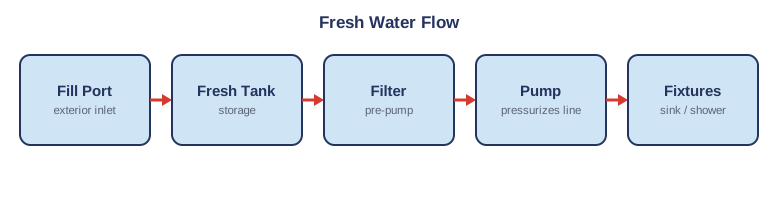
The fresh water system is a potable system and must remain isolated from all waste plumbing. At minimum, it includes a storage tank, fill port, vent, pump, filtration, water heater, and distribution lines.
In van conversions, fresh tanks are typically located inside the insulated envelope, often under a bed platform or cabinetry. This reduces freeze risk and simplifies maintenance. Skoolies have more flexibility but often place larger tanks either inside or in insulated underbody compartments.
The critical design priorities are:
- Clean fill and vent routing to prevent contamination of the potable supply.
- An accessible tank for inspection and sanitation, not one buried behind permanent finish work.
- Minimal dead-end plumbing to reduce stagnation and bacterial growth in unused branch lines.
- Serviceable pump and filter locations that don't require tearing out cabinetry to reach.
A good benchmark: if you cannot easily drain, inspect, and sanitize the tank, the design is incomplete.
Grey water system design
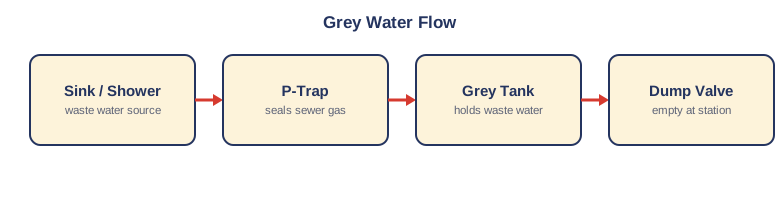
Grey water systems collect wastewater from sinks and showers and are required in almost all builds, regardless of toilet choice.
Tank sizing is typically proportional to fresh water capacity and usage habits. For example, a 40-gallon fresh tank paired with a 30 to 40-gallon grey tank is a common ratio for off-grid builds.
Key considerations:
- Gravity-assisted drainage whenever the layout allows it, rather than relying on a macerator pump for every run.
- Proper venting to prevent slow or gurgling drains.
- Dump accessibility — valve placement matters as much as tank location when it's time to actually empty it.
Portable grey tanks are more common in vans due to space constraints, while skoolies more often use fixed tanks.
Black tank vs. composting toilet
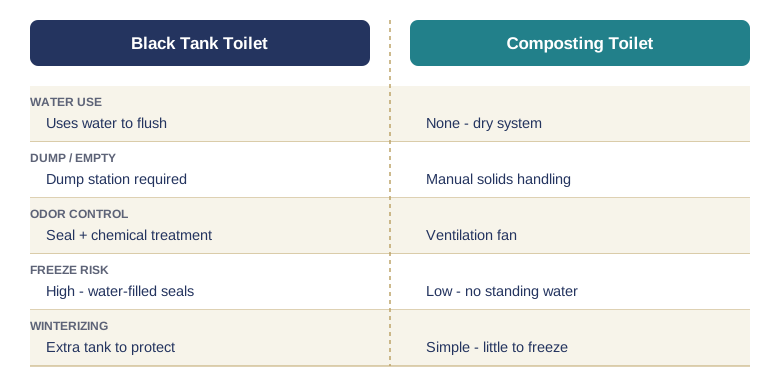
This is one of the most consequential system decisions in the whole build, and it's covered in full in the skoolie toilet options guide — here's how each option changes the plumbing system around it.
A black tank system:
- Uses water for flushing.
- Requires dump station access.
- Introduces odor control and seal maintenance requirements.
- Adds winterization complexity, since it's another tank and valve set that can freeze.
A composting toilet:
- Eliminates black water entirely.
- Reduces water usage.
- Requires manual waste handling and ventilation.
- Does not eliminate grey water needs — you still need a sink and shower system.
For cold-weather users, composting toilets significantly reduce freeze risk and simplify plumbing, since there's one less water-filled tank and valve assembly exposed to winter temperatures.
Tank placement and mounting
Tank placement must be decided early because it affects structure, plumbing routing, and thermal performance — retrofitting it later usually means cutting into finished work.
All tanks must be:
- Mechanically secured against movement under braking, cornering, and rough roads.
- Accessible for inspection and repair, not sealed permanently behind a wall.
- Positioned with drainage in mind, so gravity does as much of the work as possible.
Underbody tanks require reinforced mounting and protection from road debris. Interior tanks require space tradeoffs but are easier to manage long-term.
Underbody vs. interior tanks
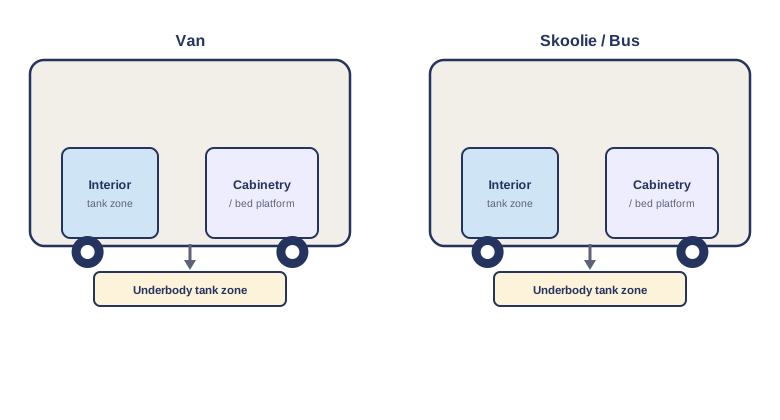
Underbody tanks:
- Save interior living space.
- Increase exposure to freezing and road damage.
- Require insulation, shielding, and often heat tracing to survive winter.
Interior tanks:
- Occupy valuable living space.
- Are significantly easier to protect from freezing.
- Simplify plumbing and maintenance access.
In vans, interior tanks are strongly favored due to limited insulation capacity underneath the vehicle. Skoolies can go either way but require more engineering for underbody setups — see the heat loss and thermal implications section below before committing to an underbody layout.
Freeze protection and winterization
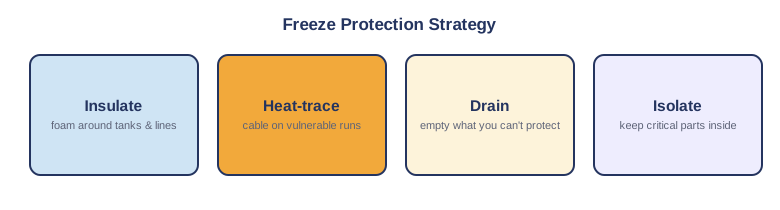
Freeze protection should prioritize system design over active heating. Heat tape is a backstop, not a substitute for keeping vulnerable components out of the cold in the first place — see the full winter heat-loss guide for the shell-level insulation and air-sealing strategy this plugs into.
Effective strategies include:
- Keeping critical components inside the heated envelope rather than hanging them underbody by default.
- Insulating exposed tanks and lines as the first line of defense.
- Using heat tape only where necessary, since it's an ongoing electrical draw, not a free fix — size it into your off-grid electrical planning if you're running it off-grid.
- Designing for complete or partial drain-down, so the system has a fallback when active heat isn't available.
A robust system allows you to isolate and drain vulnerable sections without disabling the entire water system.
Toilet seals and trap notes
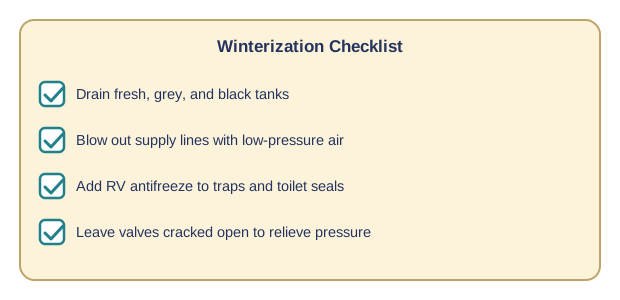
Toilet seals and plumbing traps are common failure points in freezing conditions, and they're easy to overlook because they're small compared to a tank.
Key practices:
- Avoid leaving standing water in traps during storage or extended cold snaps.
- Use RV antifreeze when winterizing rather than assuming residual heat will be enough.
- Maintain seals to prevent drying and cracking, which shows up as leaks or odor long before it shows up as a frozen failure.
Conventional RV toilets are especially vulnerable if not properly winterized, since their seals and valve assemblies hold water by design.
Heat loss and thermal implications
Tank placement directly affects thermal performance, and it's one of the clearest places where plumbing decisions and insulation decisions are really the same decision.
Underbody tanks:
- Experience constant airflow and heat loss from wind exposure while driving and while parked.
- Require significantly more insulation and protection to reach the same reliability as an interior tank.
Interior tanks:
- Benefit from ambient cabin heat, effectively getting freeze protection for free whenever the living space is heated.
- Reduce freeze risk dramatically compared to any underbody option.
This decision ties directly into the overall insulation and heating strategy of the build — read the winter heat-loss guide alongside this one if you're still deciding on tank placement.
Common mistakes
- Treating plumbing as separate from thermal design. Tank placement is a thermal decision as much as a plumbing one — they can't be planned in isolation.
- Placing tanks where they cannot be inspected. If reaching a fitting means cutting into finished cabinetry, the design will get skipped during maintenance, not fixed.
- Assuming composting toilets eliminate all waste planning. They remove black water, but grey water, ventilation, and solids handling are still real systems that need real design.
- Installing underbody tanks without freeze protection. An underbody tank with no insulation or heat trace is a guaranteed winter failure point, not a maybe.
- Failing to design for full drain-down. Every system needs a way to be fully emptied for storage, severe cold, or repair — not just a way to be filled.
- Mixing potable and waste systems. Fresh and waste plumbing must stay physically isolated; any cross-connection is a contamination risk, not just a code violation.
Decision tree (quick reference)
Answer the questions below to get a tailored steer on tank placement and toilet type for your build.
Run the numbers for your build
Compare wet-bath, standalone shower and toilet footprints against bus dimensions.
Open the Bathroom Space Planner →