Toxic Materials in Skoolie, Van Life, and RV Builds
A practical, ranked look at off-gassing, plastic saturation, and indoor chemical exposure — and the alternatives worth the extra cost.
The highest-risk mobile builds aren't defined by one bad product — they're built as a chemistry sandwich: spray polyurethane foam against the shell, vinyl flooring glued across the subfloor, MDF cabinetry, solvent contact adhesive on walls and ceilings, polyurethane foam bedding and upholstery, synthetic carpet, flexible plastic water hose, and fragranced cleaners masking whatever's left over. In a house, those products are spread across a much larger volume of air. In a van or bus, they can surround the occupant from floor to ceiling within a few hundred square feet, and vehicle interiors see extreme heat, freezing, and vibration that most indoor-air research is based on much milder conditions.
Plastic can't be eliminated from a safe modern build — electrical insulation, plumbing, and safety enclosures are sometimes necessary — so the goal here isn't a fantasy "chemical-free" bus. It's identifying which materials carry the most real exposure risk, which certifications actually mean what they claim, and which choices are cheap to get right early and expensive to fix once the walls are closed.
Key conclusions before you buy materials
- Improperly mixed or improperly cured spray polyurethane foam is the single most serious irreversible material failure — a bad install can require demolishing walls, ceilings, wiring, and cabinets to remove it.
- Large-area flexible vinyl and PVC deserve far more scrutiny than flooring marketing gives them — plasticizer emissions rise sharply with heat, and a parked vehicle routinely exceeds the temperatures used in most flooring safety claims.
- Cheap MDF, particleboard, and laminated cabinetry can turn nearly every interior wall into an emission surface, and perform poorly in a vehicle regardless of chemistry — heavy, moisture-sensitive, and hard to repair.
- Installer exposure during spraying, gluing, coating, or sanding can be far higher than the occupant's exposure later — treat two-part chemistry as an industrial process, not a weekend DIY step.
- Microplastic and nanoplastic shedding from plastic tanks, PEX tubing, and stored water is a distinct, currently developing concern separate from chemical off-gassing — degradation from UV, chlorine/chloramine exposure, heat, and age causes plastic components to physically shed particles, not just leach chemicals, and this deserves its own evaluation rather than a footnote under "drinking water."
- "Low VOC," "BPA-free," "food grade," "natural," and "CertiPUR-US" are limited claims, not proof a product is nontoxic — each certifies a specific thing, not the whole finished product.
- Materials that are mechanically fastened, removable, washable, and replaceable are safer design choices than permanently glued assemblies, because a failed material can actually be removed.
- Electrical insulation, plumbing, and safety enclosures are necessary plastic — the goal is eliminating unnecessary plastic surface area and high-emission formulations, not trading away fire or electrical safety for a "plastic-free" claim.
Ranked: the materials that matter most
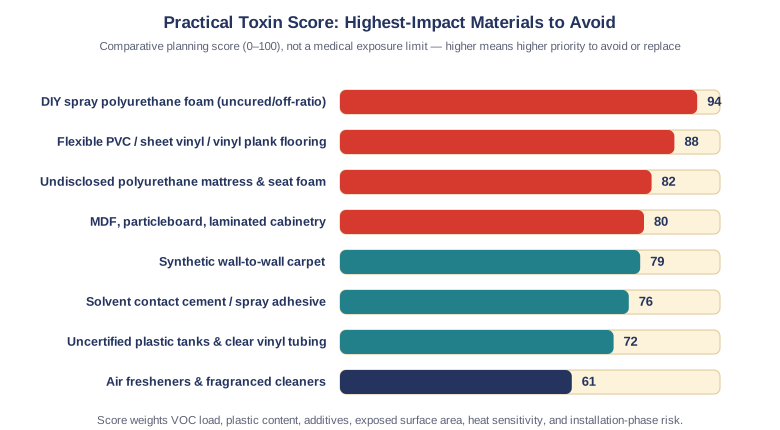
This is a comparative planning tool, not a medical or regulatory exposure limit — it weights VOC/reactive chemical load, plastic content, additives, emission persistence, exposed surface area, heat sensitivity, food/water contact, microplastic/particle shedding, and dust/fiber generation, plus an installation spike for materials that are far more hazardous while being applied than once cured.
| Material or assembly | Practical verdict |
|---|---|
| DIY two-part spray polyurethane foam, improperly mixed or cured | Avoid DIY application — professional install only, with documentation |
| Flexible PVC, sheet vinyl, vinyl plank, vinyl wall covering | Avoid over large areas, especially floors |
| Solvent contact cement, spray/construction adhesive used broadly | Minimize aggressively; prefer mechanical fastening |
| Undisclosed polyurethane mattress/seat foam, treated upholstery | Replace where practical with disclosed, whole-product-tested materials |
| MDF, particleboard, hardboard, low-cost laminated cabinetry | Avoid in living space; use solid wood or NAF/ULEF plywood |
| Synthetic carpet, foam pad, rubber-backed flooring | Poor full-time choice; avoid wall-to-wall installation |
| On-site epoxy, polyurethane, fiberglass resin | Controlled, ventilated use only, before occupancy |
| Uncertified plastic tanks, clear vinyl tubing, aged/UV-exposed PEX and HDPE, stagnant plastic plumbing | Replace or isolate; verify NSF/ANSI 61 on every wetted component; treat microplastic shedding as a separate concern from chemical migration |
| High-solvent paint, varnish, stain, primer | Apply before occupancy, cure under ventilation |
| Air fresheners, fragrance sprays, scented cleaners | Remove immediately; source control instead of masking |
| Exposed or disturbed fiberglass/mineral wool | Acceptable once enclosed and undisturbed |
| NSF/ANSI 61-certified HDPE tanks, PEX/polyethylene kept cool and flushed | Acceptable, practical compromise |
| NAF or ULEF plywood with a verified low-emission finish | Strong practical choice for walls, floors, cabinets |
| Stainless steel, glass, ceramic, mechanically fastened metal | Lowest chemical load |
A certified, properly installed polymer component can carry less real risk than a corroding unverified metal fitting or a mold-prone natural insulation — health-first building means comparing complete systems, not treating material names as moral categories.
Spray polyurethane foam: the worst-case failure
Spray foam reacts inside the vehicle from isocyanates, polyols, catalysts, blowing agents, and flame retardants. During application, isocyanates can cause eye/throat irritation, coughing, skin reactions, and occupational asthma through sensitization — NIOSH identifies isocyanates as a leading chemical cause of work-related asthma and has found personal MDI exposure exceeding criteria during foam-spraying operations, with sensitized individuals able to react to very small later exposures.
Correctly proportioned, fully reacted foam is not the same as foam sprayed too cold, onto a wet substrate, off-ratio, too thick, or without adequate ventilation. A foam failure can sit behind nearly every finished wall and ceiling, and removal may mean destroying interior paneling, wiring, and cabinets to get it out — a poorly mixed adhesive can be removed from a panel; a poorly mixed foam shell can contaminate the entire build.
Better alternatives: formaldehyde-free mineral-wool batts or boards, disclosed-treatment sheep wool, cork or wood-fiber board where weight and moisture allow, or mechanically retained automotive polyester insulation. No insulation is automatically safe — check binder chemistry, flame-retardant and pest treatment, and moisture behavior regardless of material.
Professionally installed spray foam can still be appropriate for difficult curved cavities or thermal-bridge control when the installer is qualified, substrate temperature/moisture is correct, ratio and equipment are checked, and the space is ventilated and inspected before enclosure.
Vinyl flooring and composite wood
Vinyl, PVC, and "luxury vinyl plank"
Flexible PVC typically needs plasticizers, stabilizers, and processing aids to stay flexible and fire-resistant. Studies have measured phthalate migration from PVC flooring into indoor dust, and one controlled study found modeled DEHP emissions from vinyl flooring rising from about 0.9 µg/m³ at 23°C to roughly 10 µg/m³ at 35°C and 198 µg/m³ at 61°C — an increase of close to tenfold between 23°C and 35°C, a temperature range a parked vehicle routinely exceeds. "Luxury vinyl" is still vinyl; heat, abrasion, and age all increase the exposure pathway.
Better alternatives: solid hardwood or softwood with a low-emission finish, genuine linoleum or cork with disclosed binder chemistry, or sealed NAF/ULEF plywood as the finished floor, with removable natural-fiber rugs instead of installed carpet.
MDF, particleboard, and laminated cabinetry
Composite wood can use formaldehyde-emitting resins. EPA's TSCA Title VI sets formaldehyde emission standards (matching CARB's limits) for hardwood plywood, particleboard, and MDF, with third-party certification required — but "TSCA Title VI compliant" doesn't mean formaldehyde-free, and formaldehyde is a known human carcinogen at higher exposures. Apart from emissions, MDF and particleboard perform badly in vehicles regardless of chemistry: heavy, vulnerable to edge swelling, hard to dry once wet, and difficult to repair.
Better alternatives: solid wood, NAF (no-added-formaldehyde) or ULEF (ultra-low-emitting-formaldehyde) veneer-core plywood, and stainless or aluminum cabinets in wet zones — specify the finished panel, not just a general "EPA compliant" claim.
Adhesives, mattresses, upholstery, and carpet
Solvent adhesives
Contact cement bonds flexible wall liner, foam, and laminate quickly, but using it across walls and ceilings turns the whole interior into a curing surface. EPA identifies adhesives, coatings, and paints as major indoor VOC sources, with potential short-term effects including irritation, headache, and dizziness. The safest adhesive is often no adhesive — screws, rivets, clips, and interlocking joints — and where bonding is unavoidable, use the smallest amount, cure before cabinets and soft goods go in, and ventilate continuously.
Mattresses and upholstery
Polyurethane foam provides enormous internal surface area and may be treated with flame retardants, antimicrobials, and stain-resistant coatings. CertiPUR-US certifies that qualifying polyurethane foam meets specific content and emissions criteria — free of ozone depleters, certain flame retardants, heavy metals, formaldehyde, and eight regulated phthalates — but the program's own materials say it certifies the foam component only, not the whole mattress, cover, or adhesive system, and explicitly rejects "chemical-free" or "nontoxic" claims for the finished product.
Better options: a natural-latex mattress or innerspring with a disclosed fire barrier, cotton/wool bedding, and untreated, washable upholstery covers rather than stain-resistant or antimicrobial finishes.
Carpet
Wall-to-wall carpet adds a large exposed polymer surface, sheds fibers and particulate, retains moisture and odor, and is extremely difficult to remove once cabinetry is built around it. A washable, removable natural-fiber rug plus hard, repairable flooring underneath is a more practical choice for a small, moisture-prone mobile home.
Drinking water and plumbing
Plastic plumbing is a real exposure route, not an automatic emergency. Studies of PEX tubing have found it can affect drinking-water odor and release organic compounds, with temperature, stagnation, and flushing practice all influencing migration — levels are generally low in new pipe and decrease with time in service, but odor and migration both increase with longer stagnation. That's the chemical side of the story; the particle-shedding side — how plastic tanks and tubing physically break down into microplastics as they age — is significant enough to cover on its own, in the next section.
NSF/ANSI/CAN 61 sets health-effects requirements for materials and components in contact with drinking water, but it isn't a guarantee of zero migration — evaluate every wetted component (tank, fill hose, pump, fittings, sealants, faucet, filter housing), not just the tank in isolation. A certified tank connected to unverified clear vinyl hose is not a certified system.
Practical hierarchy: a stainless-steel tank and hard line is the lowest-plastic option; a certified NSF/ANSI 61 HDPE tank with certified PEX or polyethylene tubing, kept short, out of direct heat, and flushed after storage, is a reasonable and much more common compromise. Avoid clear vinyl potable-water hose entirely, and don't store bottled water long-term in the hottest part of the vehicle.
Microplastics and nanoplastics: the risk chemical testing alone misses
Chemical migration and microplastic shedding are two different problems. A component can pass every migration test for the substances it's built from and still physically shed particles of itself into the water as it ages — that's a mechanical failure mode, not a chemistry one, and it's the part of this topic that's moved fastest in the last two years.
Where the particles actually come from
PEX tubing degrades from the inside out through oxidative attack by chlorine and chloramine disinfectants in municipal water — this depletes antioxidants in the pipe wall, breaks down the polymer, and eventually causes physical cracking, with heat, water pressure, and age all accelerating the process. A 2025 industry analysis and a peer-reviewed study in Environmental Science & Technology both found measurable release of micro- and nanoplastic particles alongside VOCs as PEX ages, though the Plastics Pipe Institute's own research disputes that plastic piping is a significant microplastic source under normal conditions — the honest read is that this is a live, contested area, not a settled one, and skoolie/van plumbing runs hotter, sees more UV at connection points, and gets flushed less predictably than a house's buried supply line.
HDPE tanks shed the same way from a different mechanism: UV radiation drives photo-oxidation that breaks polymer bonds and fragments the surface into microplastic particles, a process that's well documented in outdoor/marine HDPE studies and directly relevant to any tank mounted where it sees sun — which describes most underbody and even many "interior" tanks near windows or a hot cabin. This is a specific reason to prefer a fully enclosed, shaded tank location over one exposed to direct sun for years of parking and driving.
What's actually known about the health question
The World Health Organization's 2019 review of microplastics in drinking water concluded they "don't appear to pose a health risk at current levels" for particles larger than about 150 micrometers, which the body doesn't readily absorb — but WHO was explicit that the underlying data was limited, that smaller particles and nanoplastics may behave differently, and that more research was needed before that conclusion could be considered final. That caveat has aged into real findings: independent studies since then have detected microplastics in human blood, lungs, liver, kidneys, and — in a 2024 Nature Medicine study of decedent brain tissue — found measurably higher concentrations in brain samples than in liver or kidney, with concentrations rising between 2016 and 2024. Separate 2025 reviews link micro/nanoplastic exposure to oxidative stress, inflammation, and disrupted lipid metabolism in laboratory studies, and note that nanoplastics small enough to cross the blood-brain barrier appear to be the most biologically active size class.
None of this adds up to a proven, quantified dose-response relationship for a person living in a van or bus — that research doesn't exist yet for anyone, in any building type. What it does mean is that "not yet shown to be harmful" and "shown to be harmless" are different claims, and the more recent evidence has moved toward the former, not the latter, since WHO's 2019 baseline. Bottled water is a useful illustration of how fast this data is developing: a 2024 Columbia/Rutgers study using newer imaging technology found roughly 240,000 identifiable plastic particles per liter in tested bottled water — 10 to 100 times more than earlier estimates — with 90% of them nanoplastics too small for older detection methods to count at all, and PET bottle abrasion (from squeezing and repeated cap use) as a likely source.
What this changes about tank and plumbing choices for a build
- Treat "NSF/ANSI 61 certified" and "won't shed microplastics" as two different questions. Certification addresses chemical migration; it doesn't test for long-term particle shedding as the material ages, UV-weathers, or sees repeated freeze-thaw and vibration cycling unique to a vehicle.
- Shade and enclose plastic tanks rather than mounting them in direct, years-long sun exposure — the UV-driven fragmentation mechanism is well established even where the health significance of the resulting particles is still being studied.
- Flush PEX and any stagnant plastic plumbing section after storage, and avoid long dead-leg runs where water sits in contact with plastic and disinfectant residue for extended periods, which is exactly the degradation pathway described above.
- Don't rely on long-term stored or repeatedly reused disposable plastic water bottles as a primary drinking-water container in a hot vehicle interior — reusable stainless steel avoids both the plasticizer-migration and particle-shedding pathways at once.
- A point-of-use filter rated for particle removal (not just taste/odor) is a reasonable, inexpensive mitigation regardless of how the underlying health-effects research eventually settles — it doesn't require the causation question to be resolved to be worth doing.
- Stainless steel remains the lowest-uncertainty choice for a tank, drinking-water container, or hard plumbing run precisely because it removes both the chemical-migration and the particle-shedding pathway, not just one of them — this is a stronger reason to spend more there than the VOC-only framing gave it credit for.
Kitchen and food-contact materials
Prefer stainless steel, cast iron, glass, and lead-free ceramic for cookware and food storage.
Melamine tableware: FDA testing found melamine generally doesn't migrate into most foods, but measurable migration occurred into acidic foods held at 160°F for two hours in laboratory testing — under real-use conditions (cold juice, ~15 minutes) migration was roughly 250 times below FDA's acceptable level, but the agency still recommends not microwaving or heating acidic foods on melamine dinnerware.
PTFE (nonstick) cookware: intact PTFE used within normal cooking temperatures is not equivalent to an overheated pan — polymer fume fever ("Teflon flu") is linked to pans overheated above roughly 500°F, typically from an accidentally unattended empty pan. Avoid preheating an empty PTFE pan, discard damaged cookware, and use stainless or cast iron for high-heat cooking.
"BPA-free" claims: frequently mean a different bisphenol analog (BPS, BPF) was substituted rather than removed — treat "BPA-free" as marketing language, not proof of endocrine safety.
Electrical systems and batteries: safety first, not plastic-free
Wire insulation, connectors, battery housings, breakers, and protective enclosures are essential safety components — the health-first objective here is preventing overheating, arcing, and battery failure, not stripping away certified electrical polymers in pursuit of a "plastic-free" claim.
Lithium-ion battery thermal runaway can rapidly release flammable and toxic gases — commonly hydrogen, carbon monoxide, carbon dioxide, and various hydrocarbons, along with respirable metallic particulates that can exceed occupational exposure limits during a fire event. Flooded lead-acid batteries can release hydrogen during charging without adequate ventilation.
Lower-exposure design: use listed/certified components, follow the manufacturer's temperature and enclosure requirements, keep batteries outside the primary sleeping air volume where feasible, prevent battery-compartment air from reaching the cabin, size wiring and fusing correctly, and never conceal high-current connections permanently. In normal intact use, certified wiring and enclosures are a far lower chronic-exposure concern than an improperly cured spray-foam or solvent-coated interior — their risk is dominated by failure conditions, which correct installation and fusing are what actually prevent.
Fiberglass, coatings, and cleaning products
Fiberglass and mineral wool can irritate skin, eyes, and the respiratory tract during handling — ATSDR describes this as generally reversible "fiberglass itch" that resolves after exposure stops, with OSHA limits of 5 mg/m³ respirable / 15 mg/m³ total dust. Cut outside the vehicle, use appropriate protection, and enclose the material completely once installed; some binders may include formaldehyde chemistry, so look for binder-disclosed or formaldehyde-free products.
Two-part coatings (epoxy, polyurethane, fiberglass resin) can provide real corrosion protection and waterproofing, but their biggest hazard is during mixing and cure — NIOSH links epoxy resins and amine hardeners to skin sensitization, contact dermatitis, and occupational asthma. Use them before insulation and soft goods go in, with the specified PPE and ventilation, and allow a full cure before enclosure.
Cleaning and fragrance: air freshener is not air cleaning — EPA identifies cleaning products, air fresheners, and fragrances as indoor pollutant sources, and even "green" products can still contain fragrance VOCs. EPA's Safer Choice program evaluates every ingredient in a certified product against safer-chemical criteria and excludes carcinogens, reproductive toxicants, and chemicals that don't biodegrade quickly. Prefer fragrance-free cleaners, damp cleaning, and a properly filtered vacuum over any product whose job is to mask an odor rather than remove its source.
Common half-truths about certifications
- "TSCA compliant means formaldehyde-free." False — TSCA Title VI sets an emission limit; a compliant panel can still emit formaldehyde. Specify NAF or ULEF and verify the finished panel.
- "CertiPUR-US means the mattress is nontoxic." False — it certifies qualifying foam to specific criteria and explicitly doesn't cover the whole mattress, cover, or adhesive system.
- "Zero VOC means zero emissions." False — VOC-content labels and whole-product emissions testing answer different questions; a labeled zero-VOC coating can still emit other compounds.
- "No smell means no exposure." False — odor thresholds vary by chemical and by person, and some lower-volatility substances migrate into dust rather than producing an obvious smell.
- "Natural means inert." False — natural materials can still emit aldehydes or terpenes, and may contain binders, preservatives, or treatments.
- "Food grade means suitable for the whole drinking-water system." Incomplete — for tanks, tubing, pumps, and fittings, look for the appropriate potable-water certification (commonly NSF/ANSI 61) on every wetted component, not an undefined marketing phrase.
- "BPA-free means endocrine-safe." Unproven — common substitutes may also have endocrine activity.
- "All plastic is worse than all natural material." Also false — a certified, correctly installed polymer component can present less real risk than a corroding unverified metal fitting or a mold-prone natural insulation assembly.
Best alternatives by build category
| Build category | Avoid or minimize | Health-first choice | Practical compromise |
|---|---|---|---|
| Subfloor | MDF, particleboard, glued vinyl sandwich | NAF/ULEF exterior-rated veneer plywood | Sealed plywood as the finished floor |
| Walls and ceiling | Vinyl liner, PVC panels, glued carpet | Solid wood, NAF/ULEF plywood, metal panels | Removable low-emission composite panels |
| Insulation | DIY two-part spray foam | Disclosed-treatment wool, cork, formaldehyde-free mineral wool | Mechanically held polyester or limited removable foam board |
| Flooring | LVP, sheet vinyl, rubber-backed carpet | Solid wood, verified linoleum or cork | Sealed plywood plus removable rugs |
| Cabinets | MDF, particleboard, thermofoil | Solid wood or NAF/ULEF veneer plywood | Aluminum or stainless in wet zones |
| Adhesives | Solvent contact cement over large areas | Mechanical fastening | Small amounts of tested waterborne adhesive |
| Fresh water | Clear vinyl hose, unverified tank | Stainless tank and plumbing | NSF-certified HDPE plus PEX/PE |
| Mattress | Undisclosed PU foam, treated cover | Whole-product-tested latex, spring, wool, cotton | Certified foam with a washable untreated cover |
| Paint/finish | Solvent-heavy interior coating | Verified low-emission waterborne finish | Factory-finished panel |
| Cleaning | Air fresheners, fragrance aerosols | Fragrance-free simple products | EPA Safer Choice-certified products |
| Electrical | Improvised "plastic-free" substitutions | Listed components, isolated battery compartment | Standard certified electrical polymers |
Prioritized action list
Highest health impact first: eliminate DIY two-part spray foam; avoid large-area flexible PVC and vinyl; replace MDF/particleboard with NAF/ULEF plywood or solid wood; minimize solvent adhesive; choose a mattress/upholstery system with full disclosure; eliminate permanent carpet; verify every drinking-water component; remove air fresheners; ventilate during and after finishing work; design materials to be removable.
Most budget-friendly first: stop using air fresheners; switch to fragrance-free cleaners; ventilate during cooking, showering, and curing; use screws and clips instead of glue; leave plywood exposed rather than covering it with vinyl; flush stored water and keep tanks cool; use removable washable rugs instead of carpet; air out cushions and mattresses before installation.
Hardest choices to reverse later: spray foam; glued flooring; glued wall carpet or automotive liner; hidden composite-wood cabinetry; tanks installed behind finished walls; plumbing buried beneath the floor; resin-coated showers; adhesive-bonded ceiling assemblies.
Most important for families and full-time occupants: prioritize by combined occupancy time, surface area, skin contact, hand-to-mouth contact, sleeping proximity, drinking-water contact, and heat exposure — in practice that means flooring, cabinets and wall panels, mattress and bedding, drinking water, and ventilation, in roughly that order.
Frequently asked questions
Is spray foam insulation safe in a skoolie? Professionally installed spray foam, applied at the correct temperature and ratio with full cure and ventilation before enclosure, can be appropriate for difficult cavities. DIY two-part kits carry real risk of incomplete cure or off-ratio mixing that can be extremely difficult and expensive to remove once the interior is built around it.
Is vinyl plank flooring bad for a van build? It isn't automatically dangerous, but flexible PVC flooring's plasticizer emissions rise sharply with heat, and vehicle interiors regularly exceed the temperatures used in most flooring safety testing. Solid wood, verified linoleum or cork, or sealed plywood are lower-emission alternatives for a space that gets this hot.
Does "BPA-free" mean a water tank or bottle is safe? Not by itself — many BPA-free products substitute a related bisphenol (BPS, BPF) that may carry similar concerns. For a drinking-water tank or plumbing component, look for NSF/ANSI 61 certification on that specific part instead.
Is MDF cabinetry actually dangerous, or just a bad material for vehicles? Both concerns are real — composite wood can emit formaldehyde even when labeled TSCA Title VI compliant, and separately, MDF and particleboard perform poorly in a vehicle because of weight, moisture sensitivity, and difficulty repairing water damage.
What's the single highest-priority material change for a health-conscious build? For most builds, it's avoiding DIY spray foam and large-area flexible vinyl — those two combine the highest emission potential with the largest exposed surface area and the most difficult, expensive removal if something goes wrong.
Should I worry about microplastics from my plastic water tank or PEX lines? It's worth taking seriously even though the health-effects research isn't finished. WHO's 2019 review found no demonstrated risk at then-current data, but explicitly flagged that data as limited — and since then, independent studies have detected microplastics in human blood, organs, and brain tissue, with concentrations trending upward. Reduce exposure regardless of how that research settles: keep tanks shaded from UV, flush stagnant plastic plumbing after storage, avoid long-term reliance on disposable bottled water in a hot vehicle, and prefer stainless steel where you can.
Related guides
Skoolie & Van Water and Tank Planning: Sizing, Weight & Winter Guide (2026)
Heating & ClimateWinter Heat Loss in a Skoolie or Van Conversion (2026)
Kitchen & AppliancesCabinet Latches That Actually Stay Closed (2026)
Build PlanningLeak Repair and Rust Remediation for a Bus Conversion (2026)
Sources (22)